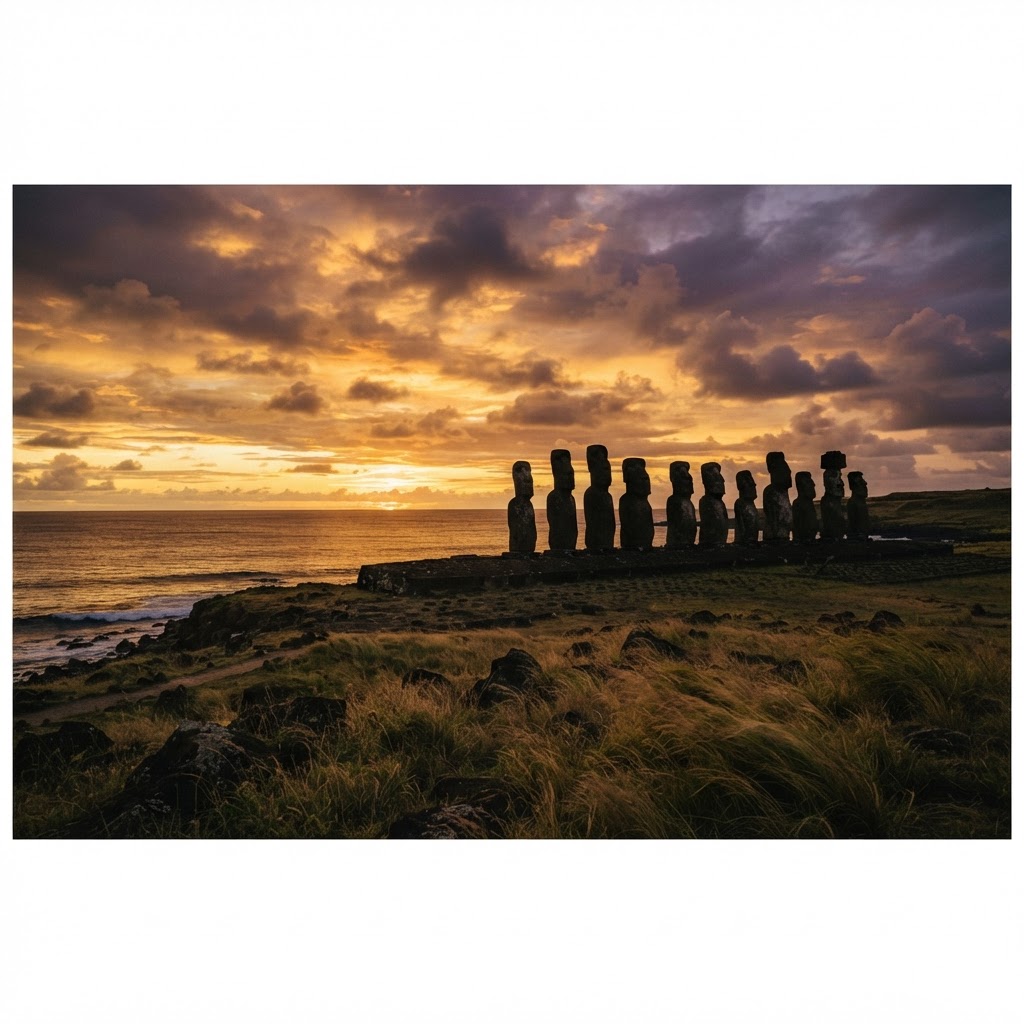
The mysterious statues on Easter Island
In the remote waters of the southeastern Pacific Ocean lies (thousands of miles from major populated landmasses) one of the world's most fascinating archaeological treasures: Easter Island, known to its indigenous inhabitants as Rapa Nui. Famous for its giant stone statues, or moai, the island has captivated explorers, historians, and travellers for centuries.

There are about 1000 stone statue monuments carved by the inhabitants approximately 800 to 1200 AD (CE). The statues. are instantly recognizable for their oversized heads, heavy brows, elongated noses, and strong chins. Contrary to popular belief, they are not merely heads. Many statues have full torsos buried beneath centuries of soil and sediment. Archaeological excavations have revealed detailed carvings on the bodies, including symbols and designs that provide insights into Rapa Nui culture.
How big are they?
The statues vary in size, with most standing between 4 and 10 meters tall. The largest completed moai weighs around 82 tonnes (about 6 double-decker London buses) , while the largest unfinished statue would have stood over 20 meters tall and weighed 200 tonnes had it been completed.
How were they moved?
Today, researchers believe that many moai were moved (sometimes several kilometres) upright using a system of ropes and coordinated teamwork. According to this theory, groups of workers "walked" the statues over rough volcanic terrain by rocking them from side to side while pulling with ropes. A 4 tonne replica was moved in an experiment this way. It is assumed this method could also work for an 82 tonne rock. This explanation aligns with Rapa Nui oral traditions that describe the statues as having walked to their destinations.
Why?
The Rapa Nui people were not building the moai as decorations. They believed the statues represented important ancestors, chiefs, or clan leaders whose spiritual power, called mana, could protect and benefit the living. The Rapa Nui believed deceased leaders continued to influence the world of the living. Building larger and more impressive moai may have been a way of demonstrating wealth and Influence between different clans.
Amazing Facts
The buried portions of the moai contain intricate carvings, even on their backs.
They were transported kilometres across the island without wheels, cranes or animals. Some weigh 82 tons.
They are more than just heads! Many have enormous bodies with torsos, arms and hands buried beneath the soil.
There are some unfinished moai still in the quarry. One would have been around 200 tonnes!
Most moai face away from the sea and toward villages.
The statues originally had eyes made from white coral.
DNA evidence strengthened the case for pre-European Polynesian-South America contact.
Some suggest the monuments weren’t positioned randomly: they may have marked valuable freshwater resources.
Stories about secret caves containing tablets, sculptures and ancestral objects have circulated for generations.
Existing found tablets contain geometric forms arranged in an unusual pattern still undeciphered. The knowledge of how to read them seems to have disappeared amid the catastrophic disruption of the Rapu Nui society in the 19th century.

Really weird fringe theories
Aliens built them. The Rapa Nui people could not have carved, transported, and erected statues weighing dozens of tons using simple stone-age technology, so extraterrestrials must have helped. However, no physical evidence has ever been found linking the moai to extraterrestrial activity. A highly advanced civilization existed on Easter Island before the Rapa Nui and created the statues. Easter Island is a surviving remnant of Atlantis or another lost continent such as Mu or Lemuria. The statues were positioned to channel Earth energies, magnetic fields, or ley lines. Certain sites have astronomical alignments.
The greatest genuine mystery is not aliens or Atlantis. It is how a relatively small society (only a few thousand people) on one of the most remote islands on Earth organized the labor, resources, religious beliefs, and engineering skills necessary to create nearly 1,000 moai over several centuries.