Most myths live on because they have at least one of these traits: They are vivid, simple, funny, scary, flattering, or easy to picture. Reality is usually messier. A myth gives you a neat little mental shortcut. Once it becomes part of school chatter, family sayings, movies, or trivia culture, it can survive for decades.
The pattern behind almost all of them
A lot of myths begin when:
a real fact gets oversimplified
a metaphor gets treated like science
a dramatic story spreads faster than a dull correction
people trust what feels true more than what is tested
1. We only use 10% of our brains

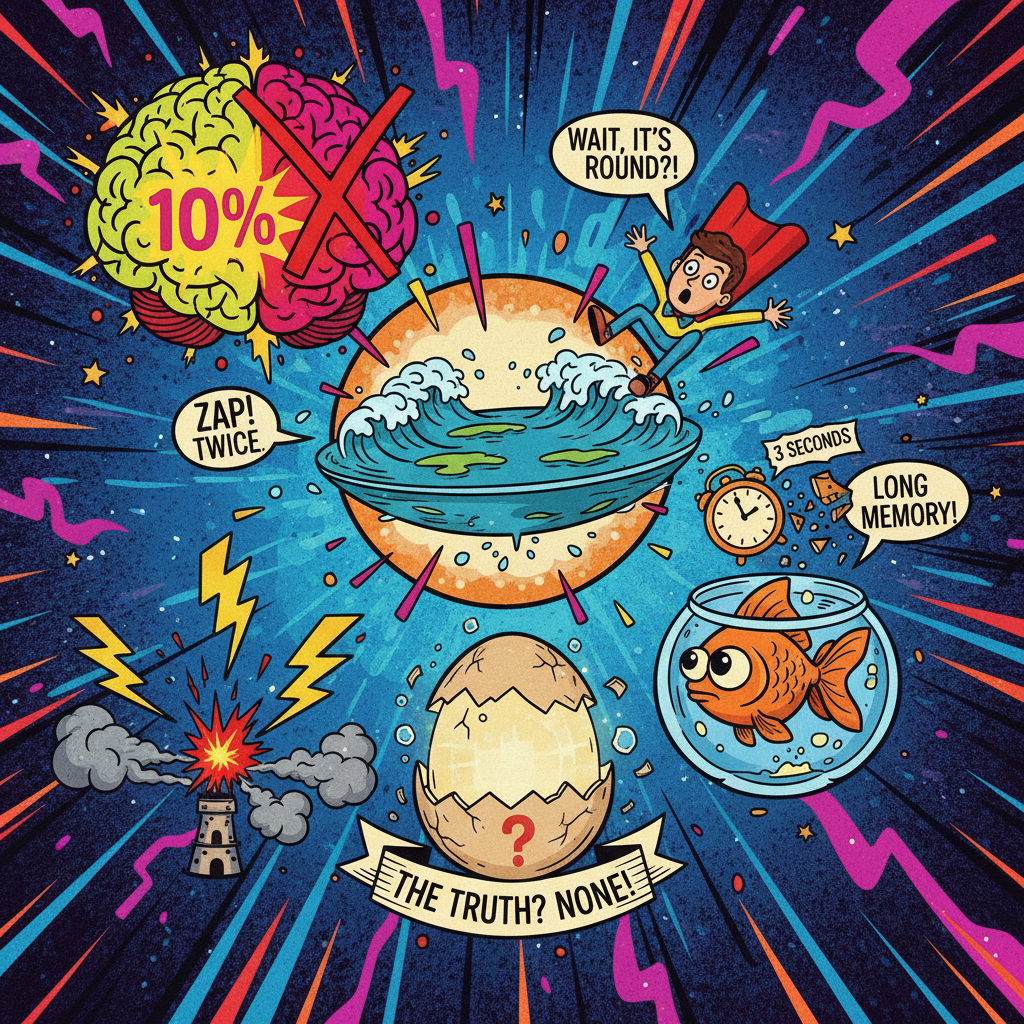
This one survives because it sounds mysterious, as if we all have hidden mental superpowers and untapped genius waiting to be unlocked by the other 90%. It is false. Brain scans, injury studies, and basic neurology all show that different parts of the brain are active for different tasks, even during sleep. If 90% of the brain were unused, damage to most of it would have little effect, which is obviously not the case. Even areas not firing constantly still have structure, support roles, and potential functions. The myth likely grew from oversimplified interpretations of early neuroscience and self-help culture. You do not use every part of your brain at maximum intensity all the time, but you absolutely use far more than 10%.
2. Goldfish have a three-second memory

This myth makes goldfish seem like tiny swimming idiots with no awareness of the world around them. False. Goldfish can remember routines, learn associations, and respond to feeding times and environmental cues over much longer periods. Experiments have shown they can be trained to expect food, navigate simple patterns, and retain information far beyond a few seconds. We believe this myth because fish are hard for humans to read emotionally, so people assume "blank face = blank mind."
3. Bats are blind

The saying "blind as a bat" did this one a lot of damage.Bats are not blind. Many species can see reasonably well, and some see quite effectively in low light. Echolocation is a bonus system, not a replacement caused by total blindness. They use sound to navigate and hunt in darkness, but that does not mean their eyes are useless. Bats often use both vision and echolocation, depending on the species and situation. Oh and they don't get tangled in your hair.
4. Bulls hate the colour red

This myth is so common that many people think red itself enrages bulls. Not really. Bulls react to the movement of the cape, not its redness. Cattle are not especially sensitive to red in the dramatic human way the myth suggests. In bullfighting, the waving cloth is what provokes the charge. The red colour is more for tradition and visual drama than for triggering the animal. A bull is far more interested in a flapping target than in whether it is red.
5. Cracking your knuckles causes arthritis
This myth has been used by parents, teachers, and annoyed coworkers for ages. The popping sound comes from changes in pressure and gas bubbles in the fluid around the joints, not from bones grinding together. Studies have not shown convincing evidence that knuckle cracking causes arthritis. It may annoy everyone within hearing distance, but it is not strongly linked to that disease. We believe it because the sound feels wrong, and many health myths begin with "that looks bad, therefore it must be bad. However obsessive habitual cracking in some cases may affect grip or soft tissues, but it is not the proven arthritis machine people claim.
6. You should wait 24 hours before filing a missing person report
This myth has caused real confusion in real emergencies. There is no universal rule requiring a 24-hour wait before reporting someone missing. In many situations, especially involving children, vulnerable adults, unusual disappearance patterns, or clear risk, authorities want to know immediately. The earlier a case is reported, the better. People believed it due to crime dramas and films that love artificial procedural rules because they build suspense. If the disappearance is out of character or concerning, report it right away.
7. The Great Wall of China is visible from space with the naked eye
This is one of the most famous "fun facts" ever taught in schools, and it is misleading. From low Earth orbit, many human-made things are difficult to see with the naked eye under ordinary conditions. The Great Wall is long, but also narrow and often similar in colour to the surrounding landscape, making it hard to distinguish. It is not some giant glowing line visible as if drawn with a marker across the planet.
8. Humans swallow several spiders a year in their sleep
A perfect horror-story myth. There is no good evidence for this. Spiders generally avoid large, warm, breathing creatures. A sleeping human is not an inviting cave. The story became popular because it is disgusting, memorable, and easy to repeat. People believed it as it pushes exactly the right disgust buttons. It is basically urban legend material, not established fact.
9. Toilets flush in different directions in different hemispheres
A classic pub fact that sounds scientific enough to win arguments. The Coriolis effect does influence very large systems like hurricanes, but in ordinary sinks and toilets, the direction of water spinning is mostly determined by bowl shape, water input, and plumbing design. Your toilet is not performing planetary physics at a meaningful scale. This myth works because it mixes real science with an everyday object, which makes it feel clever.
10. Vikings wore horned helmets
This image is everywhere, yet it is historically shaky. There is no solid evidence that Viking warriors commonly wore horned battle helmets. The popular image mainly comes from later artistic interpretations, especially 19th-century romantic art and costume design. Horns look dramatic, but they are not very practical in combat. However it does look awesome.